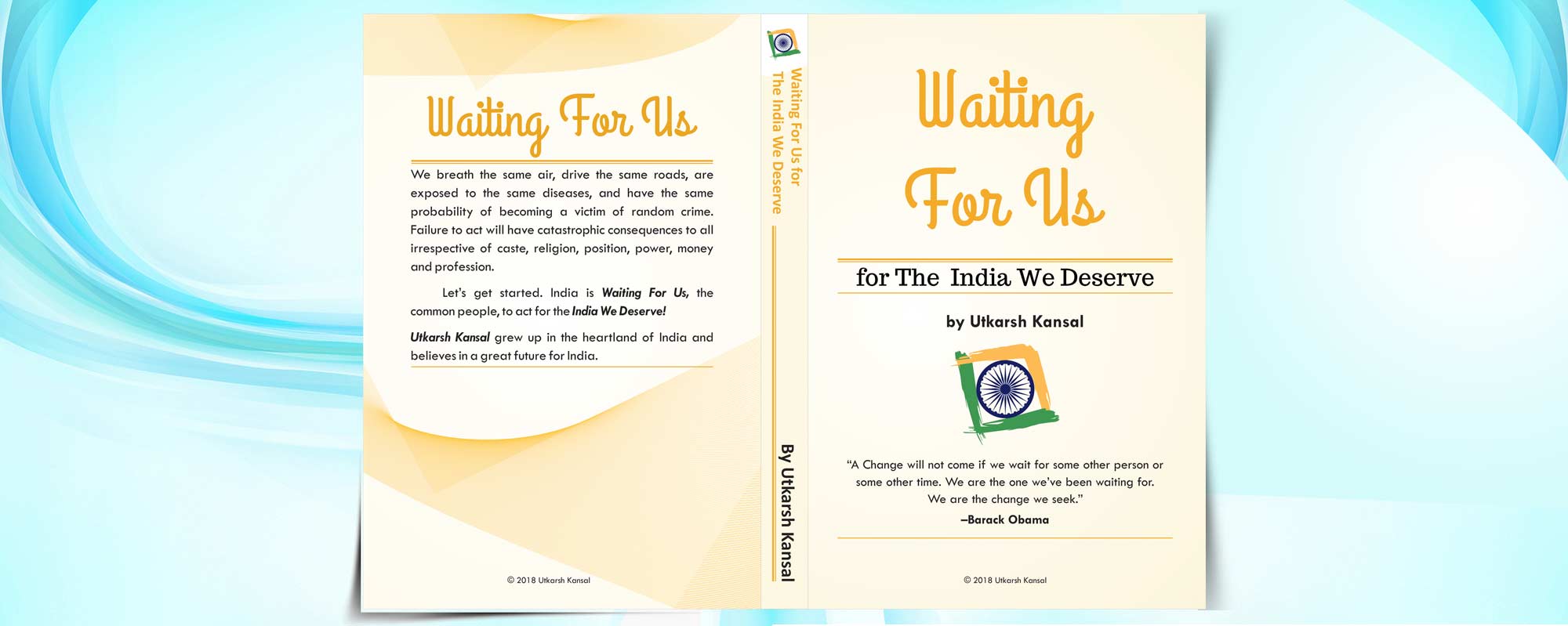
Many of my memories of being a child growing up in the heartland of India in the 1980s are marked by waiting in every aspect of life: waiting for hours for the lights to come back from the daily power cuts; waiting in line to buy groceries and other basic necessities; to withdraw or deposit money in banks, buy a movie or a train ticket, pay monthly bills and school fees, and other daily chores. Waiting was a very accepted part in the day-to-day life in India. I always wondered why nothing seemed to work without lines and waiting. Most of the schools I attended had a bare minimum of infrastructure – tables, chairs, and a blackboard. There were no libraries, no musical instruments or sports infrastructure such as a gym or a swimming pool, no sports equipment, or even a real playground with swings, slides, or a merry-go-round. As I moved to various schools, a few did not even have teachers for certain subjects. When we did have teachers, a number of them were not interested in teaching at all. In the sixth grade, my geography teacher took naps at 10 AM while the whole class played tag outside. In high school, rather than teaching in the class, certain teachers used school as a place to recruit students for their after-school private tuition programs. I could not understand why schools had such limited resources or why the overall quality of education was so poor. Most of my childhood, I lived in cities of 100,000-250,000, where cycle-rickshaws were the only local mode of transport. Very few people owned a car. Everyone had to walk long distances to get to school or to run daily errands. I would sit down to watch roadside blacksmiths, potters, jewelers, and other artisans as I took breaks while walking home from school. It was always hard to see my mother carrying groceries in harsh weather as she either could not find a cycle-rickshaw, or decided not to take one as they asked an unreasonable fare. I wondered why cities did not invest in developing local transport such as buses, trams, or even an auto-rickshaw network. Most small to medium size cities in India still lack local transport infrastructure. This has resulted in an explosion of personal vehicles such as two-wheelers, and small cars even in the small cities. This has brought new problems of traffic congestion and severe pollution even to the small to medium size Indian cities. As a child, I was horrified of out-of-town travel. As the buses always took more people than they had seats, more often than not one had to travel standing for part or the whole trip. One has to travel in India’s state transport buses to really relate with the word “miserable.” It seemed the seats on those buses were meant to transport prisoners. Buses were typically in poor condition and broke down frequently. In over forty-five degree Celsius unbearable heat, sometimes bus windows could not be opened for fresh air as they were stuck. The buses made terrible noise. Every time I traveled, I feared the bus could fall apart any moment like a cardboard box. Travelling on single-lane roads filled with potholes was a terrifying experience. First, you were tossed from side-to-side as the bus partly got off and back on the road to pass oncoming traffic. Then you were thrown off your seat every few minutes as the bus hit the potholes, which went on for the whole duration of the trip. I was at a loss to understand why public transport was so dreadful. Why did the bus companies not install air conditioning in such extreme hot weather? Depositing or withdrawing your own money from a bank felt like asking someone for a favor. After I complained to the manager that he was gone from his seat for forty-five minutes for a tea break at 10 AM when there were twenty people waiting in line, a teller once refused to serve me, accusing me of moving up the line without waiting for my turn. If you needed a demand draft (equivalent to a bank check), you had to wait for hours after depositing the cash, as if they waited for someone else to show up claiming the cash you deposited for the demand draft. I questioned why the banks could not just add extra resources to make the process easier for their customers. Anywhere you went across the country, towns looked like trashcans. Plastic bottles, paper bags, wrappers, cigarette cases, and every kind of trash could be seen everywhere. People buying food on the buses and throwing wrappers out of the window, or under their seat, was just normal behavior. There were hardly any trashcans or mechanisms for trash collection. Overflowing trash blocked city drains, and water stalled in the drains made the situation worse with horrible stink. But it hardly mattered. For weeks, everyone living on my street held their breath until they got out of the street because of the smell of stalled water and other waste. I wondered at the local government’s ineffective response to the stalled city sewers, the total absence of playgrounds, the city streets filled with potholes, and the roads so narrow that accidents seemed always to be waiting around the next turn. India has made progress over the last twenty-five years in a number of areas where the private sector has been allowed to compete. It has given hope to millions of people for a better tomorrow. But even today’s India is struggling with the same basic issues of the 1980s, with the addition of new serious issues in the mix. India is still unable to provide 24/7 electricity, sanitation, or running water to millions across the country. With time, more water shortages will be faced by people everywhere in India. Power cuts in forty-five-degree heat are still common. With the explosion of personal cars, intra and intercity traffic has become a major new issue. A twenty-five kilometer trip during office hours in major cities can take hours. Widespread trash, stalled water sewers, and severe water pollution causing disease has become a national problem. India is producing masses from its education system with few employable skills, resulting in high unemployment and significant increases in the crime rate. Dramatic air pollution, lack of basic amenities like public parks, and people living in extreme poverty, are visible everywhere. Corruption in government services and social issues, such as regionalism and communalism, has grown nationally. Overall, the quality of life for poor and middle class populations has continued to deteriorate. In the 1970s and ‘80s, if you asked most adults about such poor quality of life, the answer was always to blame it on the government. An average person did not seem to know how to fix these issues. By the time I was a teenager, it seemed like we were waiting for someone else to solve our problems, someone utterly apart from us, who did not live in our community, city, or even our country. In my early twenties I came to the United States for higher education and found myself in a system where everything just worked as expected. The power was on all the time, the highways were incredible; getting a phone took merely hours; the tellers at the bank waited on you; city streets were spotless. It was incredible to get 24/7 hot and cold running water – when hot water in winters in northern India was a luxury – and every town had a local library with thousands of books. The public schoolteachers were invested in the education of their students. Every ten years, the US produced significant innovations in all aspects of human life. Everything simply worked. I started to compare the two systems – the India of 1980s and ‘90s and the United States that I now called home. Both countries are rich in natural resources. Both countries are democratic, and their citizens share a desire for good living conditions and better lives for the next generation. The United States is widely regarded as the envy of the rest of the world, whereas India seems to stagnate in mediocrity despite having all the potential. On paper, India actually seemed to be better situated to succeed. India has a much older cultural history, as well as the force of youth on its side. Sixty-five percent of India’s population is below thirty-five. India’s geographical location, even with rudimentary tools, allows it to produce food for its over one billion population. India’s trained scientists, engineers, business professionals, and even blue-collar workers have proved themselves to be some of the best. Yet at the same time, India is not only struggling to feed its people and produce enough jobs for its youth, but it ranks at the bottom of any kind of measure around the world. India has really not provided any significant contribution in the progress of humankind over the last thousand years. Since both systems share similar sets of values and expectations, it is the policies enacted at the local, state, and national level that has allowed one system to excel while the other rots from the inside out. Waiting For Us looks at India’s problems from the inside out. It raises an alarm that if the problems are not fixed at the fundamental level, India, as we know today may not exist as a country in the next twenty-five years. India was never a country until Mughals and later the British united it and ruled it as one country. Indian states were run by dictatorships, where the majority of the population was poor and ruled by ruthless rulers. Even though there was a huge diversity of language, customs, food, and even gods, all these people did not want to go back to any kind of dictatorship of the last 2,000 years. They all came together to build a just, democratic and prosperous country. Today, that hypothesis is challenged. Unrest in Kashmir, extreme poverty in eastern states, high unemployment and poverty across the majority of India’s population, and increasing crime, makes for a perfect storm for its people and states to go on their own way. Waiting For Us analyzes how all of India’s problems are inter-related and can only be solved by implementing a large policy framework. Waiting For Us lays out such a policy framework, and recommends certain key reforms. India needs changes at all levels, including constitutional changes like limiting terms of elected and nominated politicians, removing non-confidence motions and other major changes to the Indian constitution, smaller and transparent government acting as a referee and allowing the private sector to lead industry. Waiting For Us discusses how the government’s main focus should be to implement reforms across all aspects of industry, education, environment, law and order, and national security, which impact daily lives of all Indian people. It also identifies common sense solutions already deployed around the world to similar problems to improve the day-to-day life of millions of people living in India. Waiting For Us shows how privatizing industries such as railways, garbage collection, and recycling will not only make life easier for the masses and clean up the cities, it outlines how it privatizing will also create millions of new jobs. It suggests ways to wean India’s economy from oil and coal to renewable energy sources developed and managed by the private industry. Not only will such transformation will bring 24/7 power India needs, it will also reduce the pollution choking India’s cities, and create hundreds of thousands of new jobs. The book suggests a policy framework to make tourism a $100 billion revenue generator, and to transform India into the world’s hospital by allowing private enterprise to build and manage healthcare under government oversight, making it a trillion dollar business, creating millions of new jobs India’s youth needs today. Waiting For Us advocates getting government out of major industry by selling their stock to public so these companies cannot keep on coming back to the taxpayers every year to bail them out. At the same time, the policy framework requires that the privatization or creation of these large industries be done transparently without politicians assigning the contracts to their friends and family and holding the private industry accountable for its actions. Waiting For Us proposes an education policy framework to improve access and quality of education at every level. A well-educated population not only adds to overall GDP, it helps in building a better society, helps to elect the most qualified leaders, who questions its government and keeps them honest to do their jobs. Waiting For Us provides a platform to anyone who believes in the same approach to solving India’s problem to speak up and ask these policies to be implemented in their local, state, and the national government. Using Waiting For Us as a platform, the book encourages citizens to get involved politically to promote and implement its policies, to challenge political parties promoting division based on race, religion, and caste, putting all of India’s citizens, and its next generations, in great peril, threatening India’s future as a country in the long run. Finally, at the outset, it may sound daunting to bring the policy changes Waiting For Us proposes. Some changes may sound counterintuitive and against the self-interest of India’s power centers, who are in charge of bringing about these changes as such changes will take money and power away from them. Unfortunately, India has reached a tipping point. We all breathe the same air, drive the same roads, are exposed to the same diseases, and have the same probability of becoming a victim of random crime outside of our homes. It is in everyone’s interest to make these policy changes for their children and their grandchildren’s future. Failure to act will have equally catastrophic consequences to all, irrespective of their caste, religion, position, power, money and profession. Let’s get started. India is Waiting For Us, the common people, to act for the India We Deserve!

 Waiting For Us